
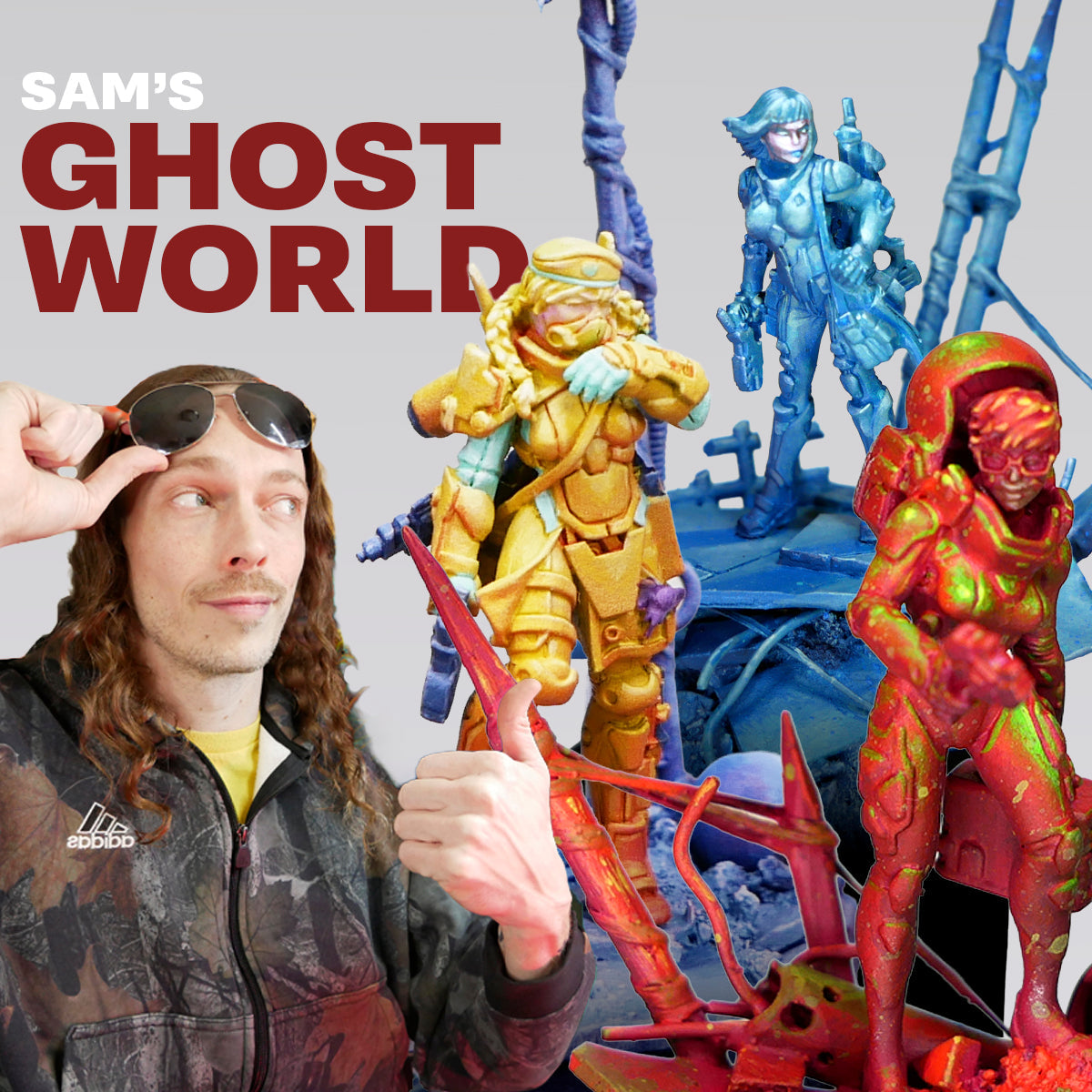
As hobbyists learn and progress on their journeys, it can become less about technical precision and more about exploration. For award-winning miniature painter and The Army Painter Factory Team member Sam Lenz, that moment exists with Ghost World.
Created as an evolving series of sci-fi display pieces, Ghost World pushes towards something more expressive, atmospheric, and personal. As Sam puts it, the project came from “leaving perfect painting to the side” and focusing instead on mood, composition, and visual storytelling.
Using sci-fi miniatures from Corvus Belli’s Infinity alongside scratch-built basing and environmental details, Sam unified the series through bold monochromatic palettes, graphic visual effects, and shared narrative language.
The result is a trio of miniatures that feel connected by colour, texture, and narrative — snapshots from the same strange universe caught mid-motion.

A Series Built Through Iteration
One of the defining ideas behind Ghost World is that each piece led naturally into the next. Rather than planning a rigid trilogy from the start, Sam allowed the project to evolve through experimentation.
That mindset is familiar to many artists. A single successful idea becomes a thread worth pulling. New colour combinations emerge. Different basing ideas appear. The visual language sharpens with every iteration.
You can see it across the series. Each miniature uses a tightly controlled palette built around dominant monochromatic tones, but every model still carries its own identity. One burns in saturated reds and oranges. Another leans into icy blues. The latest piece introduces pale violets and glowing yellows while still feeling unmistakably part of the same world.

Painting Mood Over Perfection
A renowned miniature painter, Sam is known for pushing beyond technical exercises and treating miniatures like pieces of visual storytelling. Ghost World fully embraces that approach.
Instead of chasing ultra-clean transitions or pristine edge highlights, the series leans into bold graphic shapes, exaggerated battle damage, rough textures, and dramatic colour contrast. Sam specifically cites the work of artist Pascal Blanché as an influence on Ghost World, particularly in the way the series combines painterly texture, saturated palettes, and stylized sci-fi forms that feel closer to concept art and animation than traditional military realism.
The miniatures themselves become part of a larger scene already unfolding. Who fought here? Why are these structures collapsing? What happened before this moment? Every decision contributes to that feeling:
- scratched and damaged armour
- improvised scratch-built bases
- floating debris
- surreal colour choices
- environmental storytelling
- dramatic silhouettes
Nothing feels static. Every piece suggests a story already in progress, with the viewer arriving somewhere in the middle.
Building a World Through Colour
The series also draws inspiration from Space Station Zero and its open-ended sci-fi storytelling.
That influence shows up in the way the miniatures feel less like isolated characters and more like fragments of a larger universe. The basing becomes just as important as the figure itself — broken walkways, hanging bells, industrial debris, exposed cables, and fragmented terrain all helping establish the tone of the world. Colour does the rest.
Using combinations of Colour Primers (Dragon Red, Alien Purple, Matt Black, Matt White, and Ultramarine Blue), Warpaints Fanatic (Flag Red, Diabolic Plum, Triumphant Navy, Ultramarine Blue, Amulet Aqua, Wolf Grey, Hexed Violet, Violet Coven, Daemonic Yellow, and Space Dust), and Warpaints Air (Pure Red Molten Orange, Daemonic Yellow, Cosmic Dust, Broodmother Purple, and Matt White), Sam pushes saturation while still maintaining atmosphere. The colours aren’t necessarily realistic and that’s the point — they’re emotional. They communicate tension, danger, mystery, and movement before you even process the details.
That’s what makes Ghost World stand out. It isn’t just about painting miniatures; it’s about building visual narratives through colour, texture, and experimentation. And maybe most importantly, it’s a reminder that growth often happens when you stop trying to paint perfectly and start trying to say something.