

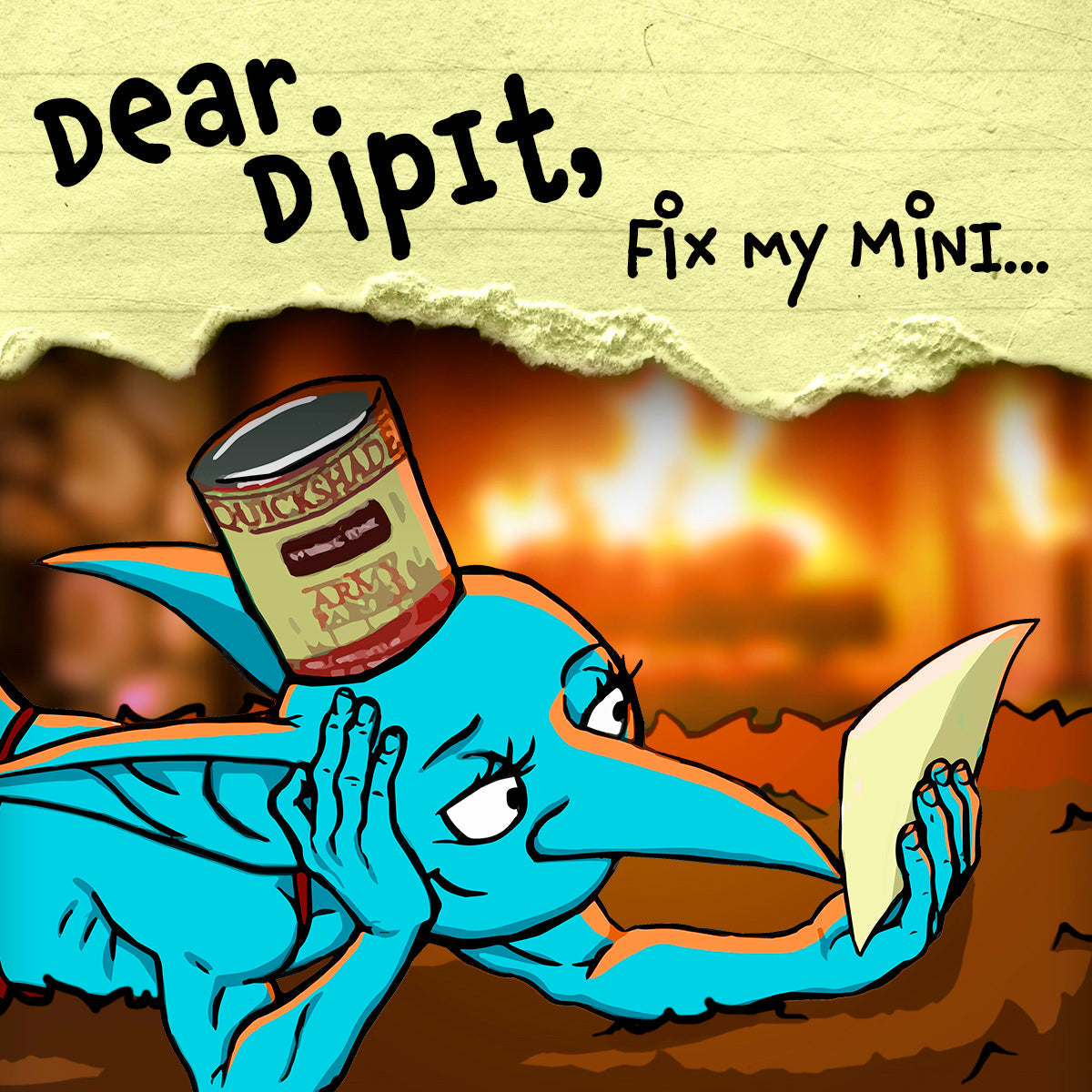
Dear DipIt,
I’m pretty new to miniature painting, and no matter what I do my paint looks streaky. It doesn’t go on smoothly, and I can see brush marks everywhere — especially on flat areas like armour or cloaks.
Am I doing something wrong? Is my paint bad? Have I wrecked my mini forever?
— Streaky in Seattle
Hi Streaky. First things first: you haven’t ruined your miniature. This isn’t anything to worry about. Streaky paint is one of the most common issues beginners run into, and it usually shows up right when you’re trying to get a smooth basecoat. It’s frustrating, but it’s also completely fixable. More importantly, it’s a normal part of learning how paint behaves.
Let’s break down what you’re seeing and how to fix it.
What You’re Seeing
If your paint looks streaky, it usually shows up like this:
- Visible brush strokes across flat surfaces
- Patchy coverage where the colour isn’t even
- Areas that look thin in some places and thick in others
This tends to be most noticeable with lighter colours like white, yellow, or red, where smooth coverage is naturally harder to achieve.
Why Your Paint Looks Streaky

Streaky paint usually comes down to a few common causes — and sometimes it’s a combination of them.
- Your paint is too thick. This is the most common culprit. Thick paint doesn’t flow smoothly off the brush, so instead of levelling out, it leaves visible strokes behind. Acrylic paint needs to be thinned.
- You’re trying to cover your mini in one coat. It’s very tempting to try and get full coverage straight away, especially when the first layer looks patchy. But miniature painting tends to work better when you apply multiple coats of thinned paint. Thin layers may look streaky at first, and that’s normal. They smooth out as you build them up.
- You’re painting over paint that hasn’t dried. Acrylic paint dries quickly, especially in thin coats, but not instantly. If you go back over an area too soon, you can break the surface and create weird textures.
- Too much pressure on the brush. If you’re pressing too hard with your brush, the bristles spread out and leave marks instead of laying down a smooth layer.
- Your paint consistency is off. Yes, paint can also be too thin. If it’s overly diluted, it won’t cover evenly and can pool or separate, leading to streaky finishes.
- The surface isn’t prepped. Painting onto unprimed or poorly primed surfaces can make paint behave unpredictably and appear streaky because it isn’t adhering properly.
How to Fix and Prevent Streaky Paint

Let’s start with the simplest fixes first.
- Thin your paint, but not too much. Your paint should flow smoothly off the brush, not drag across the surface. A good rule of thumb is to aim for a consistency where the paint still has body but moves easily. If it feels sticky, heavy, or leaves texture behind, it’s too thick. Follow our guide on paint consistency (with visual aids).
- Use multiple thin coats. Instead of trying to get full coverage on your mini’s surface in one go, apply thin, controlled layers and let each one dry fully before the next. The first layer will often look streaky; that’s expected. The second and third are where things start to smooth out.
- Let each layer dry properly. If you take one thing away from this, leave it alone. Walk away if you have to. Use this as an excuse to buy a cute timer if you need to. Going back into an area too soon is one of the fastest ways to create streaks and rough texture. Even if it looks uneven, let it dry completely before fixing it.
- Use lighter brush pressure. Let the paint do the work. Use gentle strokes and avoid pressing the brush into the surface. If your brush is splaying out, you’re pushing too hard.
- Paint in controlled directions. On larger flat areas, try to move your brush in the same direction. This helps keep any remaining texture consistent and less noticeable.
- Check your primer and surface. If your paint doesn’t seem to be adhering to the miniature properly — it’s sliding around, separating, or refusing to cover — it might not be you. Make sure your miniature is properly primed before painting. Priming is an important foundation.
After That…
If your miniature still looks streaky, don’t panic. In most cases, you can fix it by continuing to apply additional thin, smooth layers on top. The texture often evens out as you build up the paint.
And if it doesn’t? It’s still not the end of the world, I promise. Many techniques like weathering, washing, and highlighting naturally reduce the visibility of minor imperfections. You can take what you learned and apply it on your next mini.
DipIt’s Final Take
Streaky paint feels like something’s gone wrong, but most of the time, it’s a sign you’re learning one of the most important fundamentals in miniature painting: paint control. Smooth results don’t come from bending the paint to your will. They come from working with the paint — building up thin layers, letting them dry, and trusting the process.
You’ve got this.
Tools That Can Help
While honing your brush control and paint application is up to you, proper tools can make it easier. We have a variety of brushes to fit your hobby.